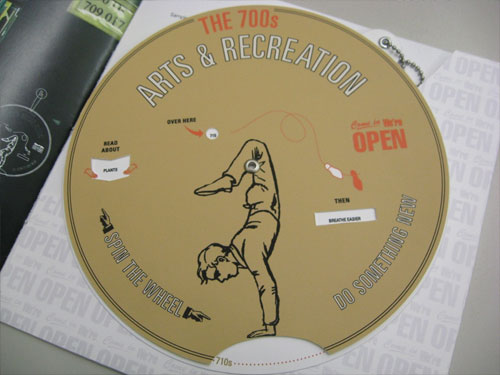



Come In, We're Open! Rick Prelinger, co-Founder of the Prelinger Archives, says: For me, visiting the public library each Saturday morning was a family ritual. I recall hours spent leisurely browsing the stacks—my eyes skimming the spines for a word, color, or texture that enticed me to reach for a book. There was no agenda—I just happened upon whatever seemed interesting or inspiring. We now live in an age when information is available at the click of a button (and the correct query). Throughout college, my trips to the library became increasingly query-based and decreasingly enjoyable—research papers for art history classes dictated searches. In my adult life in New York City I rarely set foot in a public library, preferring instead to order books online or browse at the local bookstore. When I began graduate school in Providence, I rediscovered the library with renewed interest. While conducting research for a project about libraries, I discovered the richness of the collection in the downtown branch of the Providence Public Library—not only does it house over 1.4 million materials available to its 74,555 registered borrowers, it also offers special collections such as the Nicholson Whaling Collection and the Updike Collection of Books on Printing, a patent office, early childhood programs, afterschool homework help, free internet access, computer training courses, and even practice rooms for pianists. In short, there is a lot to do at the library, yet it always seems rather empty. A solution proposed by Come In, We’re Open, is to engage visitors with a series of game-like systems—to free them from the computer query and help them regain or rediscover the joy of browsing. First, a giant wheel called “Merry-Go-Browse” welcomes them in the atrium. Library patrons are invited to spin the wheel, which directs them to an area of the stacks according to Dewey Decimal range. Once inside the stacks, a handheld “Dew-Wheel” (figure 06) acts as a more specific guide. For the children and teens of today, there is so much “virtual” stimuli competing for their attention—video games, television, electronic gadgets, etc. Come In, We’re Open takes them away from the computer for a moment, and presents them with a new way to think about exploration. For adults, the browsing-based system encourages them to discover the unfamiliar and rediscover the joys of experiencing the library. The “Open Catalog” is a set of card catalog boxes scattered throughout the stacks. The patron is invited to take a card, and follow the instructions. Ultimately, the games will not find a book or specific activity for the player, but will prompt discovery. Because much of the process is left to chance, library patrons will undoubtedly stumble across something new that they otherwise would not have found. |
 |